Ward Gauderis

Hello! I’m an FWO PhD Fellow in Brussels studying compositionality as a mathematical foundation for deep learning. I use tensor networks and category theory to analyse neural representations as induced by the computations encoded in a model’s weight structure.
Instead of reading tea leaves in activation space, I treat the model’s weights as a formal compositional system, where local mechanisms compose into global properties. Emergent behaviour then becomes a direct function of the algebraic wiring, and the black box divides into parts small enough to conquer.
My work proposes tensor models to bridge neuro-symbolic AI (NeSy) and mechanistic interpretability (MechInterp), asking how models compose concepts to generalise… or not.
Q-CHARM
How can compositional design improve compositional behaviour?
My FWO-funded project, Q-CHARM, takes this question seriously by distinguishing a model’s architecture (its compositional design) from the structure that emerges during learning (its compositional behaviour). The relationship between the two is less obvious than it looks. Deep networks cannot efficiently learn compositional functions from data alone, so what you build in shapes what you can hope to get out.


I work along two complementary paths, imposing explicit structure before training (NeSy) and exposing implicit structure after training (MechInterp). Embedding domain structure guides learning towards representations that align with human understanding and generalise well.
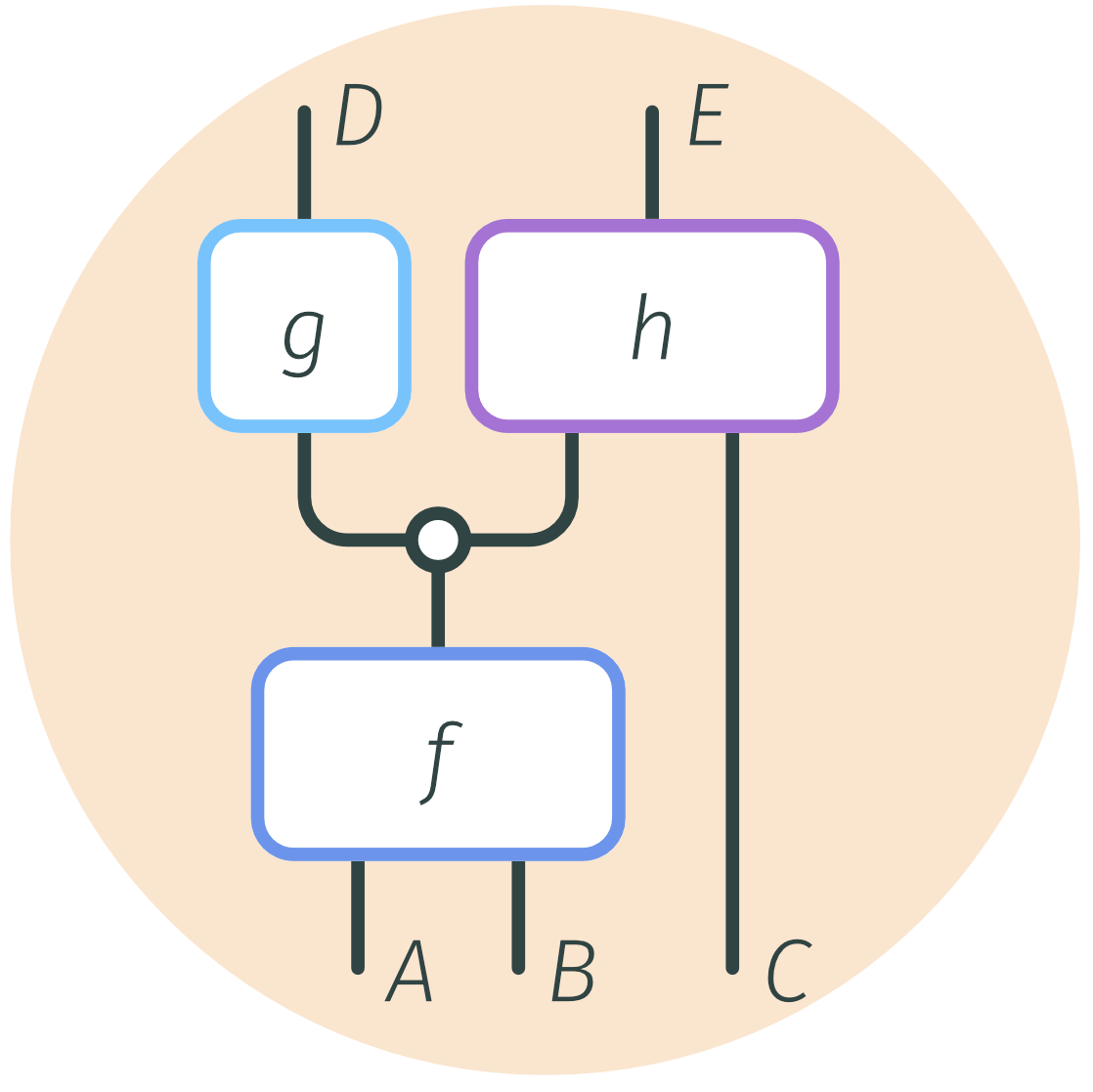
I use categorical string diagrams (life is too short for indices) to formalise models as rigorous mathematical objects, separating high-level Syntax (symbolic rules and structure) from low-level Semantics (subsymbolic representations). As a devout Yoneda disciple, I see no other way to reason formally about behaviour beyond the training set.
The practical blueprint lies in tensor models, which unify the expressivity of neural networks with the tractability of tensor networks. Because their weights possess a well-understood geometry, structural analysis works both before and after training. Applied category theory and NeSy have long relied on them, but MechInterp has barely picked them up.
Compositional Interpretability


Current mechanistic interpretability lacks formal foundations, relying on post-hoc activation heuristics that often assume a layer-by-layer stratification. This makes it nearly impossible to tell whether a feature is causally useful globally or just a local artefact.
The CompInterp framework shifts focus from isolated features to their interactions as first-class citizens. Measurable interpretability needs formal decompositions rather than data-dependent heuristics.
- Unified Algebra: Formulating weights, data, and subcircuit interactions via tensor contraction lifts standard matrix decompositions (SVD, ICA, etc.) to complex architectures. The result remains a tensor model, so discovered mechanisms trace back to the full architecture.
- Weight-Based Analysis: Tensor networks capture higher-order relations between representation spaces. Analysing their polynomial coefficients directly in the weight geometry keeps our conclusions independent of the training distribution, unless we explicitly want otherwise.
- Disentangling Interactions: Decompositions must balance complexity and faithfulness to filter out spurious correlations. Both properties are themselves compositional, so they propagate through the tensor model.


Research Interests
If you want my full attention, just mention any of these…
- Compositionality in AI: Category theory, string diagrams, geometric deep learning
- Mechanistic Interpretability: Weight space analysis, parameter decompositions
- Neuro-symbolic Architectures: Tractable and probabilistic models, tensor logic
- Quantum-ish Mathematics: Tensor networks, Hilbert spaces, information geometry
- Effective Theories of DL: Renormalisation, algebraic geometry, stochastic complexity
- Models of Cognition & Creativity: Active inference, conceptual spaces
Hobbies
When I’m not agonising about model structure, I’m probably skating through the city, singing and playing piano, or falling down a philomathematical rabbit hole. I also love building FOSS, playing chess or other (board) games, and conversations that stretch the brain a little.
news
| Sep 07, 2026 | We organised a tutorial on the evolution of interpretability at the AIMLAI workshop (ECML PKDD 2026)!  |
|---|---|
| Aug 21, 2026 | Our work on tensor similarity is at the Tractable Probabilistic Modeling workshop (UAI 2026)!  |
| Aug 12, 2026 | I gave a talk on moving from mechanistic to compositional interpretability at the Interpretable Deep Learning seminar!  |
| Jul 11, 2026 | Our compositional interpretability poster is at the Compositional Learning Workshop (ICML 2026)!  |
| Jun 29, 2026 | I presented compositional interpretability at the Theory of CS & Computational Creativity workshop (ICCC 2026)!  |
| Jun 09, 2026 | I demonstrated the CompInterp framework to the Flanders AI steering group!  |
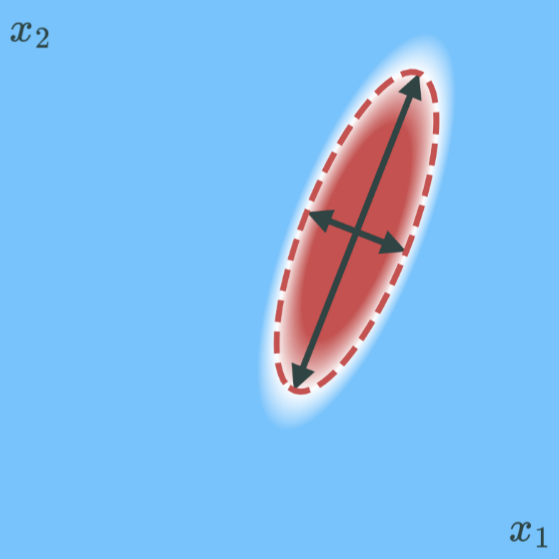
| May 12, 2026 | Our work on finding manifolds got a plenary pitch at the Flanders AI Research Day!  |